HYROX Knee Pain – What is It and How to Protect Your Long-Term Joint Health
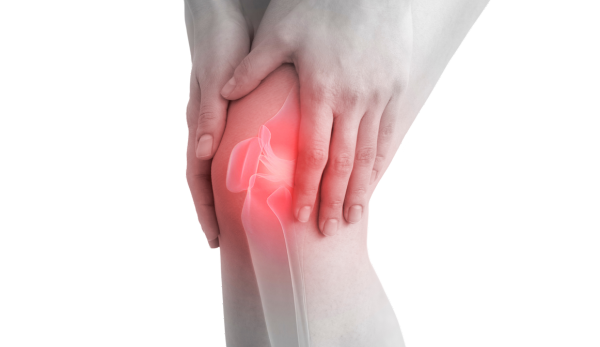
Within years, HYROX has risen quickly as one of the most challenging fitness competitions in the world. At each event, athletes combine functional-fitness workouts with repeated running intervals, testing their endurance, strength and mental toughness. Although the sport is growing rapidly with fitness enthusiasts and hybrid athletes, some participating in these events are starting to face problems with HYROX knee pain.
The nature of high-volume running, sled pushes, lunges, rowing, burpees and the like place great demands on the knee joint. The untrained muscle fibre can wear quickly with repeated training, and increase the risk of discomfort and injury in athletes who train too much or too soon.
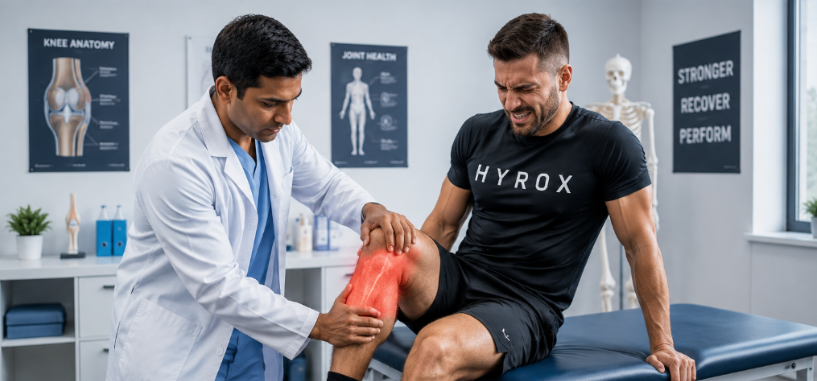
However, the long-term health of our knees when we are running with this type of intensity must be understood if we hope to keep performing without irreversible damage. If knee pain continues or worsens, visit the doctor for sports injury rehabilitation to determine the cause and start treatment, preferably from a skilled sports orthopaedic specialist such as Dr. Nagraj Shetty. Dr Shetty employs his expertise in arthroscopy, sports orthopaedics and knee preservation procedures to enable active individuals safely and securely return to their desired sport.
How HYROX Puts Specific Stress on the Knees
Unlike other endurance races or strength competitions, HYROX incorporates both into one event. Athletes performed repeated bouts of running and functional fitness stations that place cumulative stress on the joints.
Repetitive Running
HYROX Events: Every HYROX event consists of several different segments of running. Heavily loaded running is known to repeat loading on the knee joints, particularly at patellofemoral joints and adjacent soft tissues (i.e., retinaculum, synovium).
Weighted Lunges
Weighted walking lunges demand a great deal of knee stability and control. Inadequate technique or muscular exhaustion will put a lot more force upon ligaments, tendons and cartilage.
Sled Pushes and Pulls
Both of these exercises yield high force production via the lower extremities. The knees not only have to absorb and transmit large loads as before, they also have to stay in line.
Burpee Broad Jumps
Explosive take-off and landing choreography increases peak impact and overwhelms the knee’s ability to absorb shock humanly.
High Training Volume
Numerous athletes who get ready for HYROX train multiple times each week, commonly stirring up running, strength preparing and molding sessions. We may develop overuse injuries without appropriate recovery.
Consequently, knee pain in HYROX is a growing problem for new and returning competitors alike.
HYROX Knee Pain : Common Causes You Might Have
Remember, not all knee pain is the same. Depending on the athlete’s anatomy and training habits, a different structure within the knee can also become irritated or injured.
Patellofemoral Pain Syndrome
Commonly referred to as “runner’s knee,” this condition occurs when the kneecap is not tracking properly in the groove. Typical features are a painful sensation around the front of the knee when running, squatting, going up or down stairs, and sitting for long periods.
Patellar Tendinopathy
The patellar tendon can be strained from all of that jumping, lunging, and explosive action; it causes pain just below the kneecap.
Iliotibial Band Syndrome
Repetitive knee flexion associated with long-distance running may create friction on the outer side of a knee.
Meniscus Irritation
Placing stress upon the meniscus, which is a structure of cartilage designed to cushion the knee joint can occur from twisting, pivoting or repetitive loading.
Cartilage Overload
High impact training without sufficient recuperation may slowly damage the articular cartilage, this can bring about pain and swelling.
These are the common knee injuries among HYROX training.
HYBRID ATHLETE KNEES: THE SECRET TO BUILDING STRONG, RESILIENT JOINTS
HYROX is also creating a new type of athlete, the hybrid athlete. These are the guys that mix endurance with strength training in one program
This strategy smashes overall fitness, but we need to be smart about keeping the hybrid athlete knees healthy.
Hybrid athletes often face unique challenges because:
- They accumulate large training volumes.
- Recovery periods may be insufficient.
- Both liberal running and strength training repeatedly stress the same structures.
- Fatigue can affect movement quality.
If strength increases faster than mobility or stability capacity, abnormal joint loading can happen. This can cause chronic knee pain and decreased performance over time.
Of course, athletes who focus on quality movement and mobility work and recover in an organized manner tend to have more favorable joint health long-term.
Why does Functional Fitness knee pain happen?
An acquaintance of mine assumes that knee pain only arises from running, as the saying goes. Functional fitness knee pain is very rarely due to just one thing.
Poor Movement Mechanics
Incorrect squat depth, excessive knee valgus, or poor landing mechanics may put the knee joint under increased stress.
Muscle Imbalances
This means that weak gluteal muscles and tight hip flexors with poor core stability can affect lower limb alignment.
Sudden Training Increases
The body can only adapt to increase stress so fast, however; a sudden influx of running mileage, sled work or frequency is often too much.
Inadequate Recovery
Intensive exercise puts a lot of stress on your muscles, tendons and even cartilage and it takes time to recuperate from that impact. Insufficient recovery means potentially building up irritation in your tissues.
Identifying these issues in their beginning will protect you from an insignificant irritation that turns into a big injury.
Signs That Your Knee Pain Needs Medical Attention
Some soreness is normal for intense training The appearance of certain symptoms should not be neglected, however.
Please see a professional if you have:
- Persistent pain lasting several weeks
- Swelling around the knee joint
- Locking or catching sensations
- Knee instability or giving way
- Reduced range of motion
- Pain that worsens during activity
- Difficulty returning to training
Diagnosing injuries early means athletes are able to get back on their feet sooner and will often require less treatment down the line.
Hyrox Sports Injury Prevention For Athletes
One of the best ways is to prevent sports injuries for the athletes beforehand.
Build Gradually
Do not make any drastic leaps in training volume
Strengthen Supporting Muscles
To disperse the stress forces across the knee joint more evenly, quadriceps, hamstrings, glutes and calves also work together.
Improve Mobility
Hip joint (abduction and flexion), ankle joint (dorsiflexion), hip–ankle coupled mobility may also have an influence on the running and other functional tasks knee mechanics in someone who is limited in range of motion at the hip or ankle.
Prioritize Recovery
Adequate sleep, hydration and nutrition are important for tissue repair along with rest days.
Focus on Technique
By decreasing stress on the joints, good movement patterns make lunges, squats, sled pushes, plyometrics, etc. more comfortable;
Wear Appropriate Footwear
So with running and training shoes you have to have at least enough support depending again on your biomechanics, your training surface.
Training hard and training properly: you want to do everything you can to avoid these injuries however it is guaranteed to have a much lower risk of sustaining HYROX training injuries.
What to Do When Conservative Treatment Fails
The majority of HYROX knee pain can be managed and improved by changing what you do, physiotherapy, strength training and rehabilitation. In cases of some athletes they take further structural injuries evaluation on this.
Conditions such as:
- Meniscus tears
- Ligament injuries
- Cartilage damage
- Chronic tendon disorders
May require specialist review and advanced imaging
Patients seeking expert evaluation and treatment for sports injuries can consult Dr.Shetty’s clinic, where he offers personalized care for knee and sports-related conditions. He is also associated with renowned hospitals in Mumbai, including Lilavati Hospital, P. D. Hinduja Hospital (Khar), and Nanavati Hospital, enabling patients to access advanced surgical and non-surgical treatment options when required.
Arthroscopy vs Open Surgery for Sports Related Injuries of the Knee
In selected patients, arthroscopy may be a minimally invasive diagnostic and therapeutic option for some knee abnormalities.
These are done through small incisions, using special instruments to assess and treat conditions inside the joint. Based on the diagnosis, treatments consist of meniscus repair, ligament reconstruction or cartilage proceduresor other management of internal knee injuries. Because of the fact that arthroscopic techniques are designed to restore joint function while doing minimal damage to surrounding tissues, they are commonly used in sports orthopaedics.
While knee surgery is not needed for every athlete with knee pain, assessment early on can help identify the best treatment options.
Conclusion
HYROX is a new, exciting but challenging fitness pursuit that requires high stamina, strength and athleticism. Yet the unique nature of doing running and functional fitness together can also lead to knee pain in HYROX – especially as training loads pile up or recovery becomes low.
Being an effective hybrid athlete while maintaining and even improving the health of one’s knee during this unique sport is possible if you understand how to train smart for HYROX, The reason knees become so stressed in HYROX, understanding the hyrox training injury mechanisms behind common HYROX classes and knowing how to avoid or resolve one in yourself. The most effective approach to long-term success continues to be an emphasis on correct technique, progressive training and sports injury prevention for athletes.
When knee pain does not resolve even after rehabilitation, only a thorough assessment by an experienced sports orthopaedic specialist like Dr. Nagraj Shetty can pinpoint the problem and suggest appropriate treatment that enable athletes to return to training safely and with confidence.
To learn more about arthroscopy procedures, sports injury management, and knee preservation treatments, visit www.arthroscopysurgerymumbai.com