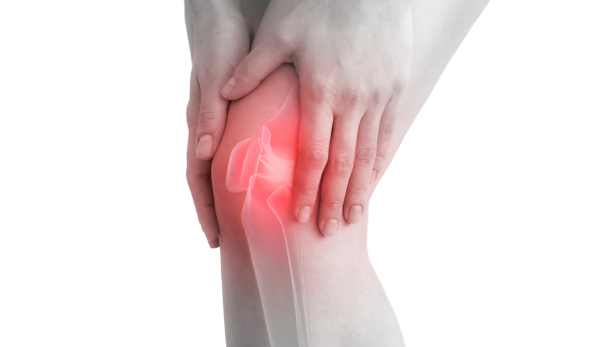
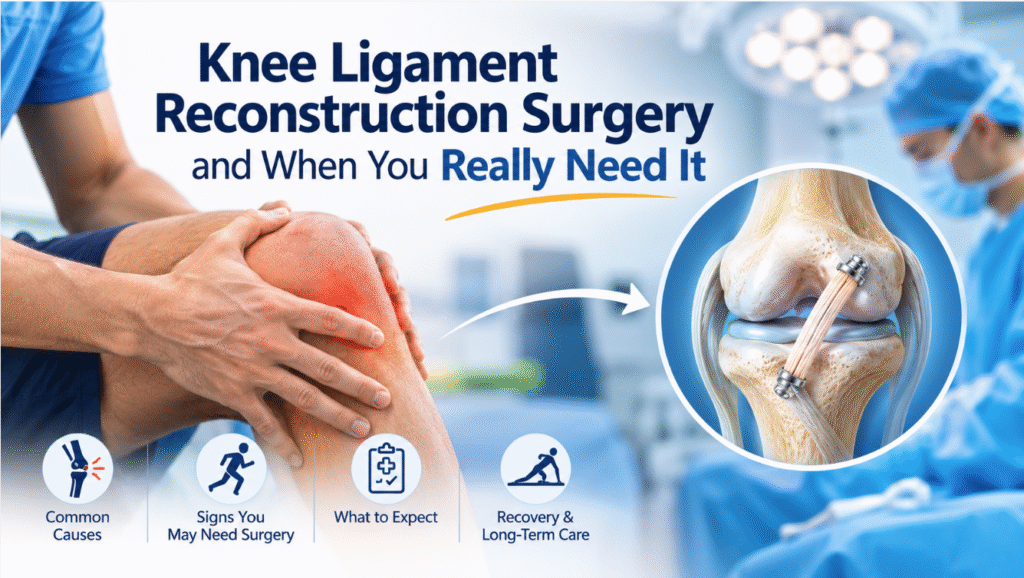
The damage to the knee’s stabilizing ligaments caused by a sudden twisting motion during a football game, an unusual landing following a jump, or a sports-related collision can result in long-term problems. Although some of the ligament injuries can be repaired through physical therapy and rest, others will need to undergo surgery so as to provide the necessary stability to prevent future damage.
A doctor may recommend a procedure called “knee ligament reconstruction surgery” if your torn ligament isn’t strong enough to help hold your knee stable during daily life tasks, and/or during athletic events.
Is every ligament tear a candidate for surgical repair? When would you recommend reconstruction?
Dr. Nagraj Shetty, an Arthroscopy, Sports Orthopaedics & Complex Knee Preservation Surgeon based in Mumbai, has specialized training for managing knee ligament injuries, which include ACL, PCL, MCL and multiple ligament injuries. To make a decision about the most suitable treatment options, it’s essential to understand the type of injury.
What Is Knee Ligament Reconstruction Surgery?
The knee joint has four large ligaments that help keep the joint stable and regulate how it moves.
ACL (Anterior Cruciate Ligament): Controls excessive forward motion of the shinbone and contributes to controlling rotational stability.
The posterior cruciate ligament (PCL) prevents the shin bone from moving too far back.
The Medial Collateral Ligament (MCL) provides stability on the inside of the knee.
LCL (Lateral Collateral Ligament): Supports the outer side of the knee.
If one of the major ligaments in your knee is torn, then it can cause instability within the joint. Patients who have a torn ligament often report feeling as if their knee is “giving out,” especially when they walk over unlevel ground, change direction, or participate in physical activities.
Knee ligament reconstruction surgery replaces the damaged ligament with a graft made of the patient’s own tendon (autograft), or occasionally with donor tissue (allograft). The graft serves as a new ligament to replace the old one and allows for restoration of knee stability.
Ligament reconstructions may also use an arthroscopic approach. This type of surgery uses several small incisions and a camera to allow the surgeon to see into the joint.
When Do You Really Need Knee Ligament Reconstruction Surgery?
A person’s need for surgery after a torn ligament will vary depending upon several factors such as: how severely the tear was sustained, whether the knee is stable enough without a repair, what types of activities the patient plans to participate in and if there are additional injuries.
Here are some situations where reconstruction may be recommended.
Complete ACL Tear With Knee Instability
An ACL tear is one of the top frequent knee injuries caused by participating in sports. These types of tears typically happen when you change directions quickly, pivot on your feet, jump up and down, or have something strike your knee directly.
A complete ACL tear may cause:
A popping sensation at the time of injury.
Rapid swelling around the knee.
Difficulty continuing physical activity.
Repeated episodes of the knee giving way.
Reduced confidence while running or changing direction.
When a person continues to experience instability in their knee after completing rehabilitation, an anterior cruciate ligament (ACL) reconstruction can be a possible solution. ACL reconstructions are particularly common among individuals who wish to resume participating in sports or other physical activities that require quick changes of direction.
Multiple Ligament Injuries
A serious accident or sports injury to the knee may cause damage to multiple ligaments. When multiple ligaments are injured, the injury affects joint stability and requires a more extensive surgical repair.
When multiple ligaments are damaged in a knee injury, the surgeon must evaluate all the damaged structures, how the knee is aligned, and whether there are other related injuries prior to beginning to plan for surgery.
Failed Previous ACL Surgery
A past ACL reconstruction can sometimes be unsuccessful due to an failed graft, another injury, tunnel placement errors or other issues.
If a patient experiences a recurrence of their ACL injury, then they may need to undergo ACL revision surgery. The course of action taken by the surgeon will depend on why the first surgery failed, as well as the current state of the patient’s knee.
Persistent Instability Despite Physiotherapy
Surgical intervention should be evaluated as an alternative when conservative management options have failed to produce results. When a person’s knee continually gives out, or is still unstable after undergoing the necessary amount of physical therapy, then surgical reconstruction of the affected ligament(s) should be discussed with a doctor.
Episodes of instability may lead to an increased risk of further meniscus and cartilage damage.
Based on the injury to the person and what they want to do after their rehabilitation is complete, a doctor specializing in treating knees will help decide if it would be best for them to continue rehabilitation or undergo surgery (reconstruction).
What Happens During ACL Reconstruction Surgery?
ACL reconstruction is among the most frequently used procedures for repairing knee ligaments. The purpose is to restore stability and allow patients to achieve the level of physical activity they desire.
Dr. Nagraj Shetty provides several types of ACL reconstructions based on a patient’s anatomy, type of injury and expected physical demands.
Some of the techniques include:
Anatomic ACL Reconstruction: Emphasizes placing the graft in a position that mimics the native attachment points of the pre-injury ACL.
The GraftLink with Internal Brace is an internal bracing method that uses a graft-based reconstruction technique for the reinforcement of the reconstructed ligament.
The BTB (Bone-Patellar Tendon-Bone) Graft: Uses the center of the patellar tendon and the two small bone sections at the end of each.
The use of a central portion of the quadriceps tendon is an option for reconstructing the anterior cruciate ligament (ACL).
There are many ways to perform this surgery. Some methods may be better than others for certain patients. Each patient will have a unique set of circumstances which will determine the most appropriate type of graft and surgical approach.
Is Arthroscopic Knee Surgery Better for Ligament Reconstruction?
Arthroscopy is a type of surgery which uses tiny cuts into the skin (incisions) to view and/or repair the inside of your joint.
With the help of a small camera placed within the knee joint during arthroscopic ACL reconstruction, the surgeon can clearly see the areas that need repair. Specialized tools are utilized to clean up the area where the graft will be positioned and correctly place the graft.
Some potential advantages of arthroscopic techniques include:
Smaller surgical incisions.
Better visualisation of the internal knee structures.
Less disruption to surrounding soft tissues.
The ability to identify and address associated meniscus injuries.
A structured rehabilitation process following surgery.
The suitability of arthroscopy is based on the type of injury and the required surgical technique.
When looking for the best arthroscopic knee surgeon, you will want to look at the surgeon’s experience treating complex ligament injuries; the surgeon’s knowledge of the various types of reconstructive surgeries that can be performed on your knee; and the surgeon’s plan for rehabilitation after surgery.
What Happens If You Ignore a Torn Knee Ligament?
If you ignore a major ligament injury, it could cause you to have continuous instability, as well as problems with the long-term well being of your knee.
An untreated ACL-deficient knee that continuously “gives out” can experience more twisting forces. These increased forces can result in a greater chance of developing subsequent meniscus tears and/or cartilage damage.
Other possible consequences include:
Difficulty participating in sports.
Reduced confidence while walking or running.
Repeated swelling after physical activity.
Difficulty performing movements involving sudden turns.
Increased risk of further knee injuries.
However, not all ligament tears cause these types of complications. In addition, many injuries can be treated effectively through conservative (non-surgical) means. A precise diagnosis will help guide the decision-making process for determining how best to treat the injury.
Recovery After Knee Ligament Reconstruction Surgery
After a person has surgery on their knee, they will experience a slow recovery period to regain full use of that joint. While the surgery itself can be considered a major component of regaining normal function of the knee, rehabilitation is also a very critical component.
The recovery process generally involves:
Early Recovery: The first part of the recovery process includes managing pain and swelling, keeping the new ligament safe from injury and slowly increasing how much you can bend and straighten your leg.
Muscle Strengthening: Physical therapy can help restore the strength of the quadriceps, hamstrings, and other muscles that surround the knee joint so they can better support it.
Improve Coordination and Control During Everyday Movements: Through exercises, you will be able to enhance your ability to coordinate, control and maintain balance throughout the course of your daily activities.
Physical rehabilitation: Patients will progressively begin to engage in activities (e.g., jogging, running, jumping) and/or sports-related tasks when it is medically feasible.
Return to Play: A return to sport must have appropriate levels of strength, stability, movement control and a functional assessment. This is not simply a matter of time.
Recovery times will differ based on the severity of the ligament damage, the type of surgery performed, and how quickly an individual heals. It is also important to follow a patient’s rehab program and attend regular follow-up appointments to ensure that they achieve the optimal results.
Choosing the Right ACL Reconstruction Surgeon
An experienced ACL reconstruction surgeon is essential for treatment of severe knee ligament injuries.
The patient should seek out a surgeon who has experience with arthroscopy, different kinds of grafts, revision surgery, as well as complex reconstructions of ligaments. In addition to finding a doctor with this level of expertise, the patient needs to know what the doctor plans on doing regarding rehabilitation after the procedure and how stable they will be in the long run.
Dr. Nagraj Shetty is a surgeon specializing in Arthroscopy, Sports Orthopaedics, Complex Knee Preservation, and Shoulder Surgery in Mumbai. Dr. Shetty’s areas of specialization are ACL Reconstruction, ACL Revision Surgery, PCL Reconstruction, MCL Reconstruction, and Multiple Ligament Reconstruction.
He completed advanced training in arthroscopy and sports orthopedics in South Korea, as well as additional advanced training in surgical procedures in several different countries.
Dr. Shetty offers surgical services to patients from throughout the world at affiliated hospitals located in Mumbai. For additional information regarding Dr. Shetty’s qualifications, areas of specialization and appointment scheduling procedures please visit Dr. Shetty’s web site.
Website: https://arthroscopysurgerymumbai.com/
ALSo Read: https://arthroscopysurgerymumbai.com/acl-tear-treatment-in-mumbai-surgery-recovery-and-rehabilitation/
Conclusion
If you have a tear of your knee ligament, it doesn’t necessarily mean that you’ll need surgery. But, if you’re experiencing long-term instability, you’ve had multiple tears or you are struggling to get back into your day-to-day life after the injury, then those things shouldn’t go unnoticed.
Knee ligament reconstruction surgery can provide improved knee stability and allow individuals to return to their normal activities, after non-surgical treatments have proven ineffective.
With a focus on arthroscopy, sports orthopedics and advanced knee preservation techniques, Dr. Shetty provides custom-tailored solutions for ACL, PCL, MCL and other multi-ligament injury conditions.
If you have experienced knee instability or have been told that you have a torn ligament, I recommend that you schedule an appointment with doctor to discuss what types of treatment may be available to you.
Learn about available treatments for knee ligaments and find out how to consult with Dr. Nagraj Shetty by contacting us on +91 88984 22089 | +91 98679 79436 | +91 99307 48794.
FAQs
Partial ACL tears, and even some full ACL tears, can often times be treated through physical therapy, changes in your daily routine and rehabilitation. Surgical intervention may be required if there are multiple associated injuries, if you experience excessive instability, or if you plan on participating in activities that require quick direction change and/or pivoting.
Recovery is different for everyone. It usually takes about 9 to 12 months (or more) to return to high-level athletics, based upon how quickly someone can regain their strength, stability, complete functional tests and make progress in their rehab program.
Most patients will eventually be able to return to walking normally after their surgical procedure. However, the use of walking aids, restrictions for weight bearing, and the need for physical therapy/rehab depends on what kind of reconstruction was performed and if there were other injuries sustained during the accident.
ACL repair is an attempt at repairing the torn ligament in specific types of injury; ACL reconstruction is a replacement for the damaged ligament using a graft. The type of procedure performed is dependent on where the tear occurs and what kind of tear it is.
Patients with potential ligament damage, chronic knee instability or other sports related knee conditions may wish to seek medical advice from Dr. Nagraj Shetty. He specializes in arthroscopic surgery for the knee as well as complex reconstruction of ligaments.