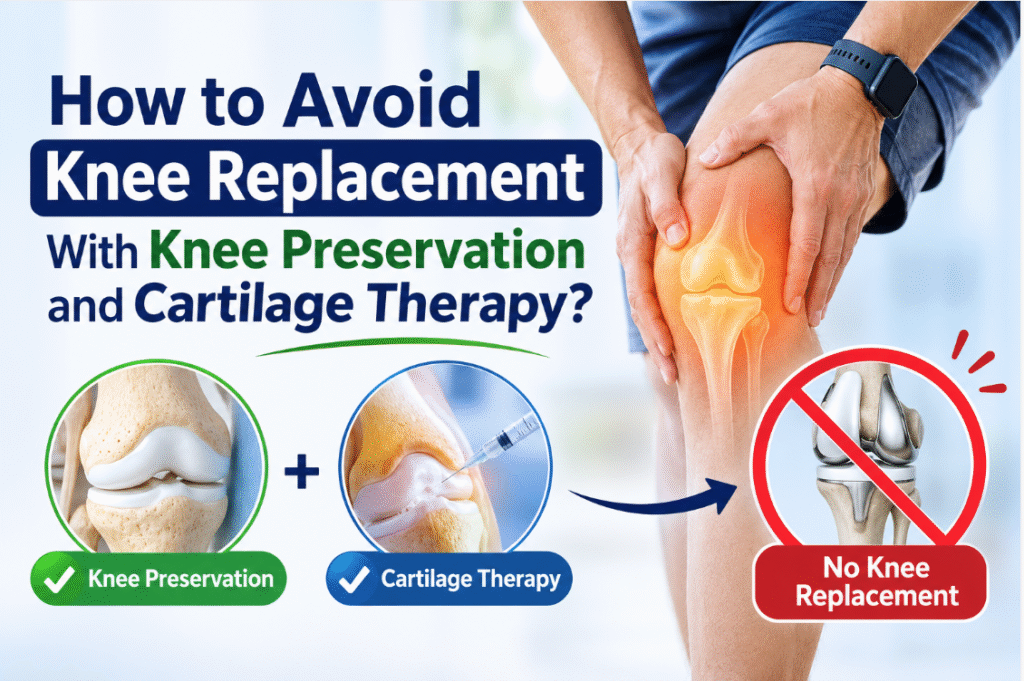
Knee pain may significantly limit what you can do (i.e., walk up/down stairs, participate in physical activity/sports). It’s very common for people with damaged cartilage, early-stage osteoarthritis, torn ligaments, etc., to worry that they will need to undergo a total knee replacement at some point. Total knee replacement isn’t necessarily the only way to treat your knee.
How to prevent a total knee replacement? A preservation of the knee joint can be used with selected candidates to maintain their existing knee joint, manage the cause of their symptoms, and possibly postpone the requirement of a replacement.
Dr. Nagraj Shetty specializes in Arthroscopy, Sports Orthopaedics, and Complex Knee Preservation, focusing primarily on preserving the original state of the knee. Dr. Shetty’s treatment plan involves addressing cartilage damage, ligament injury, meniscus problems, and alignment issues that could impact the future well-being of the knee.
What Is Knee Preservation?
The term “knee preservation” refers to the treatment of a patient’s natural knee joint in order to keep as much of that joint intact as possible rather than replacing the complete joint.
Treatment selection will vary based upon a number of variables such as the patient’s age, activity level, amount and distribution of cartilage damage, knee alignment, condition of ligaments, and general joint health. Thus, an in depth evaluation should precede any decision regarding a preservation procedure.
The preservation of the knee can include arthroscopic surgeries, restoration of cartilage, reconstruction of ligaments and other treatments to fix the way your body applies pressure to your knees.
The objective of the treatment program is more than just managing the temporary relief of a patient’s knee pain. Rather, the goal is to determine what caused the pain, treat the cause, and maintain the integrity of the patient’s own joint when possible.
Dr. Nagraj Shetty has specialized knowledge about advanced knee preservation techniques and specializes in surgical interventions that will allow his patients to continue to lead physically active lives and preserve the function of their own knees.
How Can Cartilage Therapy Help?
Cartilage is essential for allowing the bones of the knee joint to slide over one another without friction. If cartilage becomes injured, individuals can develop pain, swelling, stiffness and have trouble performing daily tasks.
The objective of cartilage therapy is to treat specific cartilage defects and when possible to repair damaged cartilage prior to considering joint replacement.
Depending upon the defects size and where it is located, several methods for restoring the cartilage can be used.
OATS
The Osteochondral Autograft Transfer System (OATS) uses a healthy portion of both cartilage and the underlying bone taken from an appropriate non-weight-bearing location within the knee joint, and transfers it to the damaged area. This may be used as a treatment option for some types of localized cartilage damage.
ACI
Autologous chondrocyte implantation (ACI) is a two-step process to restore cartilage. First, cartilage cells will be harvested from the patient’s knee. Second, these cells will be grown in a lab and then placed into the damaged part of the cartilage. ACI may be an option for certain individuals with larger cartilage damage.
Autocart
Autocart utilizes ground-up cartilage tissue for the treatment of cartilage defects. This method is designed to use alive cartilage cells to aid in the restoration of the injured site.
BMAC
Bone marrow aspirate concentrate (BMAC) uses the patient’s own bone marrow to extract a high concentration of cells. BMAC may be an option for some patients who have damaged cartilage or early-stage degeneration.
The choice of which cartilage repair method to use will depend on each person’s unique knee health status. Prior to selecting a treatment option, a complete evaluation should be performed.
Can Bracing Help Preserve the Knee?
Braces are sometimes helpful for treating certain types of knee problems because they provide support and help control how much pressure is put onto the knee.
However, a brace will not fix all forms of cartilage or structure injury. The effectiveness of a brace is based upon the underlying problem, the stability of the knee, and how aligned the knee is.
In addition to being used as a standalone non-surgical option, bracing can also be utilized as a component of a larger non-surgical treatment program. For example, if a patient has suffered a ligament injury, they will likely need to rest, undergo physical therapy (rehabilitation) and/or use a brace to treat their condition, based upon the specific injury and the extent of the damage.
What is most significant, is that a brace should not be chosen solely based on the fact that your knee hurts. First, you must identify what has caused the pain so that you may then plan your treatment correctly.
Can Knee Preservation Delay Knee Replacement?
For certain people, knee preservation may be able to extend the life of your knee joint, or help you to avoid getting a total knee replacement.
There is no guarantee that all patients who have either cartilage damage in their knees or knee arthritis will be able to avoid a total knee replacement for the rest of their lives. A variety of individual patient characteristics including, but not limited to, the health of the patient’s knee, amount of joint damage, alignment, required level of physical activity, and many others, will help determine what type of treatment plan is best for each individual patient.
By evaluating the options available for preserving a person’s knee at an early point, many issues can be resolved before the degeneration in the joint progresses to a late-stage.
For example, an area of cartilage loss (focal cartilage defect) can possibly have cartilage restored. A problem with the alignment of your leg can often be treated by performing a procedure called a high tibial osteotomy that will change how the load is distributed over your knee. When there is a problem with the stability of a ligament in your knee, it can usually be repaired through surgery to improve the stability and provide protection to the joint.
This is because when you are trying to decide what to do about avoiding a knee replacement, it is very important that you find out what caused your knee problems.
When Should You Consider Knee Preservation?
Knee preservation may be worth discussing if you have:
Localised cartilage damage
Early or moderate degenerative changes
Knee pain affecting your activity
Previous knee injuries
Ligament instability
Meniscus problems
Abnormal knee alignment
Difficulty returning to sports or exercise because of knee symptoms
The early assessment may provide a clue as to whether your knee is compatible with the preservation procedure.
Dr. Nagraj Shetty specializes in complex knee preservation; he has experience in cartilage restoration, ligament reconstruction, meniscal procedures, and osteotomies. He is committed to using the patient’s own knee as long as possible when appropriate, instead of automatically going for a total knee replacement.
How to Avoid Knee Replacement: The Importance of Early Evaluation
No one single method of care can provide assurance that a person will not require a total knee arthroplasty (TKA). On the other hand, early identification and treatment of knee disorders at the correct time can allow for possible preservation of the patient’s own native joint.
If your knee is constantly painful, swollen, stiff, unstable, or if you can no longer do things that you used to be able to do comfortably, then it’s time to have a professional evaluate your knee instead of ignoring these symptoms.
Dr. Nagraj Shetty specializes in treating patients with arthroscopic surgery, sports orthopedics and advanced knee preservation. Treatment options will vary depending upon the patient’s individual circumstances, but could include non-surgical options, use of braces, physical therapy/rehab, use of cartilage therapy, arthroscopic surgeries, ligament reconstructions, etc.
The objective is clear; to maintain the natural knee where medically feasible, so that people can continue to lead physically active lives for as long as possible.
ALSo Read: https://arthroscopysurgerymumbai.com/acl-tear-treatment-in-mumbai-surgery-recovery-and-rehabilitation/
An evaluation focused on preserving the knee can assist in determining if a natural-joint-preserving treatment option would be appropriate for you if you suffer from chronic knee pain or if you have been recommended to undergo knee replacement. To receive an assessment regarding your knee condition and what treatment options are available, contact Dr. Nagraj Shetty.
FAQs
If you wish to avoid having to replace your knee, it is dependent upon how healthy your knee is. For many patients who are able to be treated at an early stage with rehabilitation, bracing, cartilage repair/restoration, ligament reconstruction, correcting the alignment of the knee joint and/or other conservative/preservation options for treating the knee joint, they may be able to postpone or completely avoid the need for a total knee replacement.
The preservation of a patient’s natural knee joint is what is referred to as “knee preservation.” This can include such things as cartilage restoration, ligament reconstruction, meniscus procedures, osteotomies, and arthroscopic procedures.
Cartilage treatment is used to treat damaged cartilage. Some types of treatments available depend upon the size and shape of the damage. These can range from OATS, ACI, Autocart, and BMAC.
Bracing may be beneficial in managing the effects of stress on the knee in some instances. The effectiveness of bracing is dependent upon the type of knee issue, which must be assessed through an appropriate examination.
Yes, for some people, knee preservation can postpone or even prevent the need for knee replacement. This is determined by the severity of the damage to the knee joint and each individual’s health status.